Registration & Sign up Flow
Four experiments. Seven months. One goal: reverse Vimeo's declining subscriber growth through smarter registration design and personalized plan merchandising. And we succeeded!
Registration & Sign up Flow
Four experiments. Seven months. One goal: reverse Vimeo's declining subscriber growth through smarter registration design and personalized plan merchandising. And we succeeded!
Principal Product Designer
Principal Product Designer
Vimeo
2025
Growth
01
Summary
Summary
Registration & Sign-In Flow was a series of three sequential experiments that redesigned how new users sign up for Vimeo. As design lead, I worked with engineering and product marketing to modernize the registration experience, introduce a customer profiling flow, and test how the placement and presentation of plan selection could drive first-time subscriber conversions.
That last metric was the number one company KPI in 2025 and this project was taking a huge swing at it.

02
Context
Three things pointed us toward registration at the same time.
These three signals weren't sequential. They converged. The project became a way to address all of them together without losing the ability to measure each change independently.

Customer Research
Early 2025 research surfaced two clear pain points. Registration felt disjointed from the rest of the Vimeo product. And users only learned their password didn't meet strength requirements after hitting submit. Quantitative data confirmed this was driving drop-off.

Design System Modernization
Vimeo's design system, called Bokeh, was being rolled out across critical paths in the product. Registration qualified. Rebuilding the flow with Bokeh components would modernize it visually and reduce the technical debt that had been accumulating over time.
This wasn't optional. It was part of a broader company-wide effort.

Product marketing priority
Product Marketing needed a clearer picture of who was signing up for Vimeo and why. They wanted structured data on new users: their use case, their role, and their team size. Building a profiling step into registration was the most direct way to collect that data at scale.
02
Context
Three things pointed us toward registration at the same time.
These three signals weren't sequential. They converged. The project became a way to address all of them together without losing the ability to measure each change independently.
Customer Research
Early 2025 research surfaced two clear pain points. Registration felt disjointed from the rest of the Vimeo product. And users only learned their password didn't meet strength requirements after hitting submit. Quantitative data confirmed this was driving drop-off.
Design System Modernization
Vimeo's design system, called Bokeh, was being rolled out across critical paths in the product. Registration qualified. Rebuilding the flow with Bokeh components would modernize it visually and reduce the technical debt that had been accumulating over time.
This wasn't optional. It was part of a broader company-wide effort.
Product marketing priority
Product Marketing needed a clearer picture of who was signing up for Vimeo and why. They wanted structured data on new users: their use case, their role, and their team size. Building a profiling step into registration was the most direct way to collect that data at scale.
02
Context
Three things pointed us toward registration at the same time.
These three signals weren't sequential. They converged. The project became a way to address all of them together without losing the ability to measure each change independently.
Customer Research
Early 2025 research surfaced two clear pain points. Registration felt disjointed from the rest of the Vimeo product. And users only learned their password didn't meet strength requirements after hitting submit. Quantitative data confirmed this was driving drop-off.
Design System Modernization
Vimeo's design system, called Bokeh, was being rolled out across critical paths in the product. Registration qualified. Rebuilding the flow with Bokeh components would modernize it visually and reduce the technical debt that had been accumulating over time.
This wasn't optional. It was part of a broader company-wide effort.
Product marketing priority
Product Marketing needed a clearer picture of who was signing up for Vimeo and why. They wanted structured data on new users: their use case, their role, and their team size. Building a profiling step into registration was the most direct way to collect that data at scale.
03
Sequencing
Why three experiments?
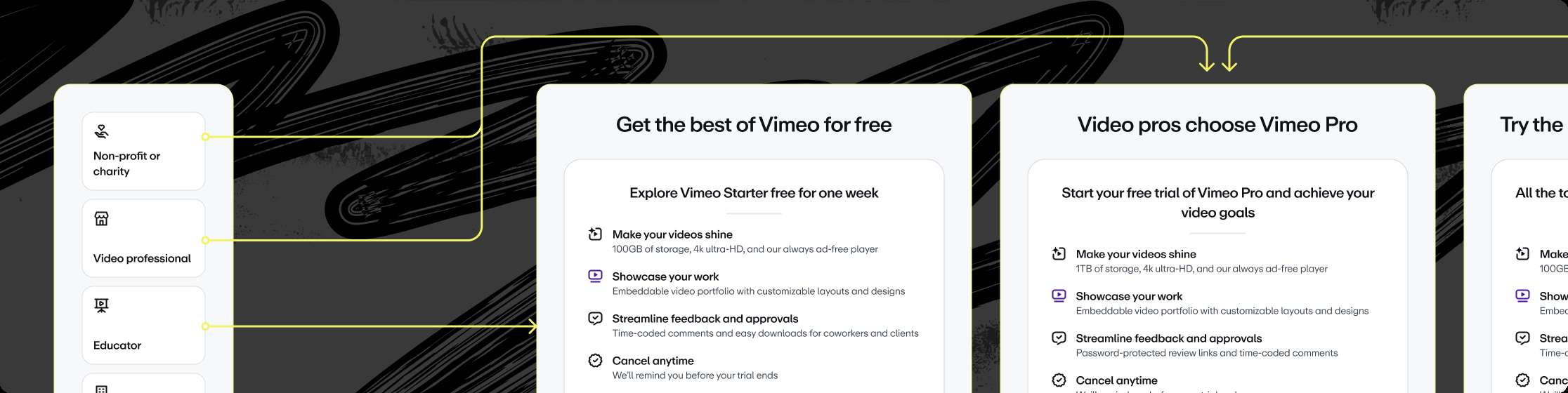
A single large redesign of registration would have been faster to ship. But it would also have been much harder to learn from. Breaking the work into three experiments let us isolate one variable at a time. If something moved the metrics, we could point to exactly what caused it.
Experiment one
System application + Profiling + Password Indicator
Applying a new design system, adding in a password strength indicator, and introducing profiling. This was a packed experiment.
Rebuilt using Bokeh
Registration flow rebuilt using Bokeh design system components
Strength indicator
Password strength indicator added: users could see in real time whether their password met the criteria, instead of finding out after submission
Profiling
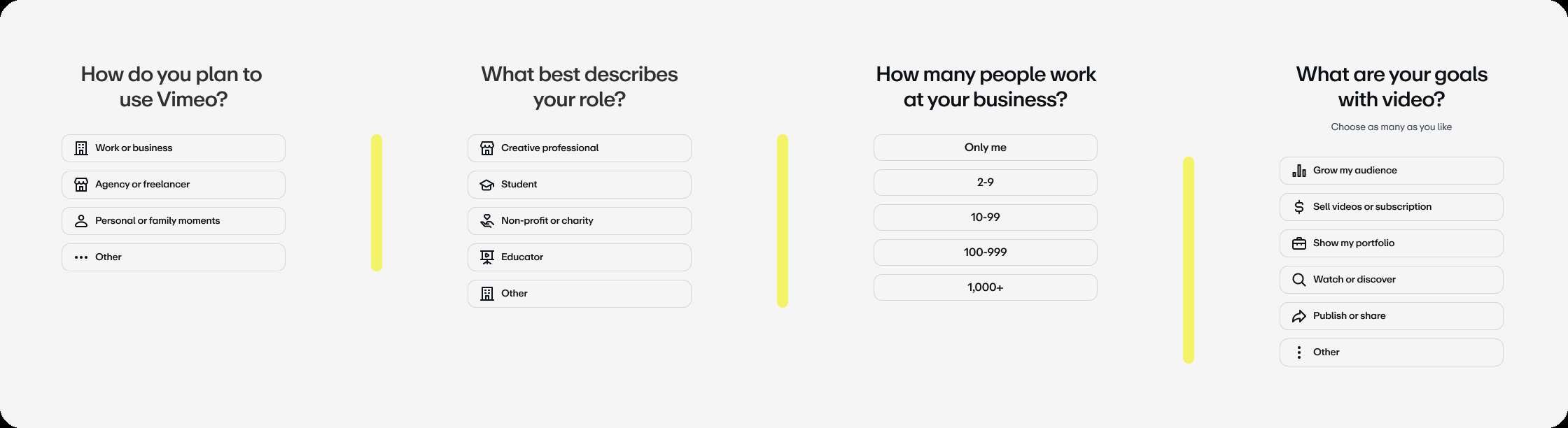
Three profiling questions added as a new step: how you plan to use Vimeo, your role, and team or business size. Each profiling question also allowed the user to Skip if they wanted.
Experiment two
Plan Selection Placement
Moving plan selection into the flow, right after profiling. Testing whether context changes conversion behavior
Experiment three
Personalized Plan Presentation
One recommended plan instead of showing all options. Using profiling data to reduce decision fatigue and drive conversion
03
Sequencing
Why three experiments?
A single large redesign of registration would have been faster to ship. But it would also have been much harder to learn from. Breaking the work into three experiments let us isolate one variable at a time. If something moved the metrics, we could point to exactly what caused it.
Experiment one
System application + Profiling + Password Indicator
Applying a new design system, adding in a password strength indicator, and introducing profiling. This was a packed experiment.
Experiment two
Plan Selection Placement
Moving plan selection into the flow, right after profiling. Testing whether context changes conversion behavior
Experiment three
Personalized Plan Presentation
One recommended plan instead of showing all options. Using profiling data to reduce decision fatigue and drive conversion
04
Research + Validation
Our research combined multiple methods to understand the registration challenge:
Qualitative Feedback
User interviews and support ticket analysis consistently surfaced frustration with the password creation flow. Users reported feeling confused when their password was rejected after submission, with no clear guidance on what was wrong.
Cross-functional Input
Product Marketing identified the need for profiling data to better understand new user composition. This business requirement aligned with the opportunity to redesign registration end to end.
Quantitative Data
Drop-off metrics confirmed the password error was measurably contributing to registration abandonment. The data validated what users were telling us directly.
Design System Mandate
The Bokeh rollout created technical urgency. Critical paths needed to be rebuilt with the new component library, and registration was identified as a priority.
04
Research + Validation
Our research combined multiple methods to understand the registration challenge:
Qualitative Feedback
User interviews and support ticket analysis consistently surfaced frustration with the password creation flow. Users reported feeling confused when their password was rejected after submission, with no clear guidance on what was wrong.
Cross-functional Input
Product Marketing identified the need for profiling data to better understand new user composition. This business requirement aligned with the opportunity to redesign registration end to end.
Quantitative Data
Drop-off metrics confirmed the password error was measurably contributing to registration abandonment. The data validated what users were telling us directly.
Design System Mandate
The Bokeh rollout created technical urgency. Critical paths needed to be rebuilt with the new component library, and registration was identified as a priority.
04
Research + Validation
Our research combined multiple methods to understand the registration challenge:
Qualitative Feedback
User interviews and support ticket analysis consistently surfaced frustration with the password creation flow. Users reported feeling confused when their password was rejected after submission, with no clear guidance on what was wrong.
Cross-functional Input
Product Marketing identified the need for profiling data to better understand new user composition. This business requirement aligned with the opportunity to redesign registration end to end.
Quantitative Data
Drop-off metrics confirmed the password error was measurably contributing to registration abandonment. The data validated what users were telling us directly.
Design System Mandate
The Bokeh rollout created technical urgency. Critical paths needed to be rebuilt with the new component library, and registration was identified as a priority.
04
Research + Validation
Our research combined multiple methods to understand the registration challenge:
Qualitative Feedback
User interviews and support ticket analysis consistently surfaced frustration with the password creation flow. Users reported feeling confused when their password was rejected after submission, with no clear guidance on what was wrong.
Cross-functional Input
Product Marketing identified the need for profiling data to better understand new user composition. This business requirement aligned with the opportunity to redesign registration end to end.
Quantitative Data
Drop-off metrics confirmed the password error was measurably contributing to registration abandonment. The data validated what users were telling us directly.
Design System Mandate
The Bokeh rollout created technical urgency. Critical paths needed to be rebuilt with the new component library, and registration was identified as a priority.
05
Solution
001 / 004
The Profiling Flow
The Profiling Flow
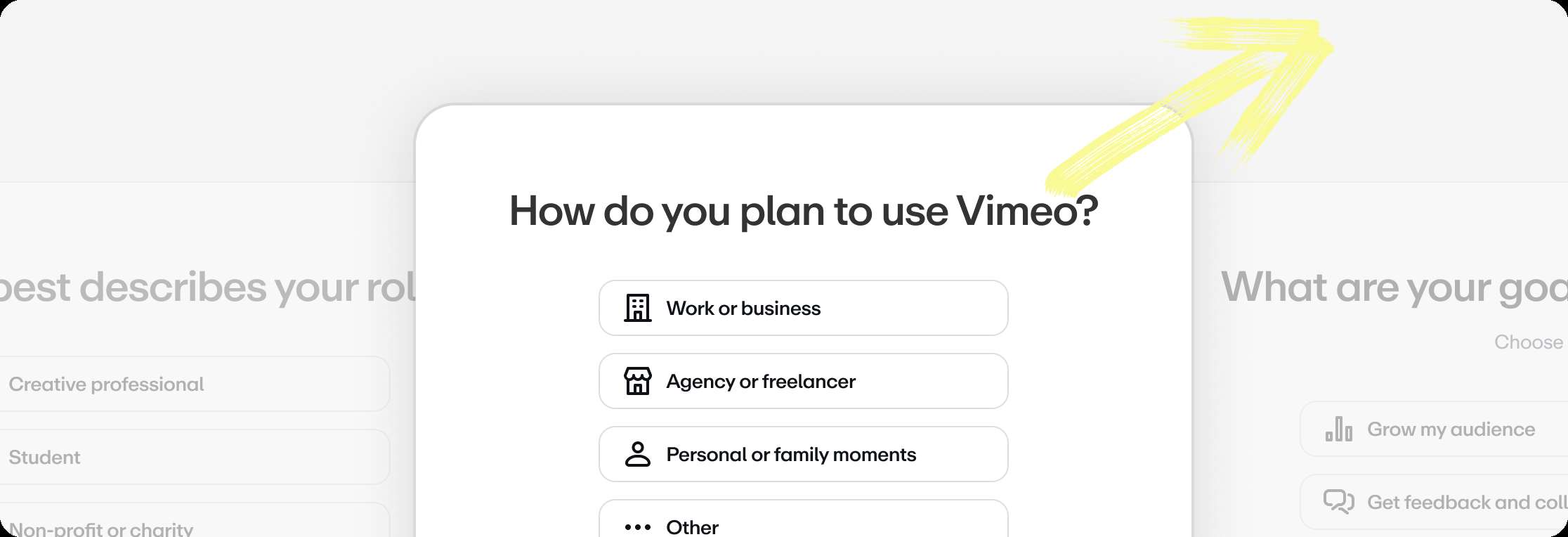
These profiling questions were a top priority for Product Marketing. The data helped build a clearer picture of who Vimeo's new users actually were and what they intended to do with the platform.
—
The three questions were designed to be low-friction and feel purposeful. Use case, role, and team size. Each page had a Skip option so users never felt trapped. The data collected here became the input for personalization in later experiments.
05
Solution
001 / 004
The Profiling Flow
The Profiling Flow
These profiling questions were a top priority for Product Marketing. The data helped build a clearer picture of who Vimeo's new users actually were and what they intended to do with the platform.
—
The three questions were designed to be low-friction and feel purposeful. Use case, role, and team size. Each page had a Skip option so users never felt trapped. The data collected here became the input for personalization in later experiments.
05
Solution
001 / 004
The Profiling Flow
The Profiling Flow
These profiling questions were a top priority for Product Marketing. The data helped build a clearer picture of who Vimeo's new users actually were and what they intended to do with the platform.
—
The three questions were designed to be low-friction and feel purposeful. Use case, role, and team size. Each page had a Skip option so users never felt trapped. The data collected here became the input for personalization in later experiments.
06
Results
First day registration rate
Lift in first day homepage visits after registration
Lift in first week homepage visits after registration
06
Results
First day registration rate
Lift in first day homepage visits after registration
Lift in first week homepage visits after registration
06
Results
First day registration rate
Lift in first day homepage visits after registration
Lift in first week homepage visits after registration
07
Reflections
Sequencing as a Design Strategy
Breaking a large registration redesign into three experiments wasn't just a risk-mitigation tactic. It was a way of learning incrementally. Each experiment gave us a cleaner signal about what was working and what wasn't. The tradeoff was speed. It took longer to ship the full vision. But the data quality at each stage was significantly better than it would have been from a single large change.
Profiling questions with a strategic plan
The customer profiling flow started as something Product Marketing needed. But it became the input that made personalization possible in experiments 2 and 3. It shifted from a data collection step to a decision-making input. That was one of the more interesting design problems in the project. The skip rate on those questions was something we were still working to reduce when I left.
Building the Thumbnail Wall
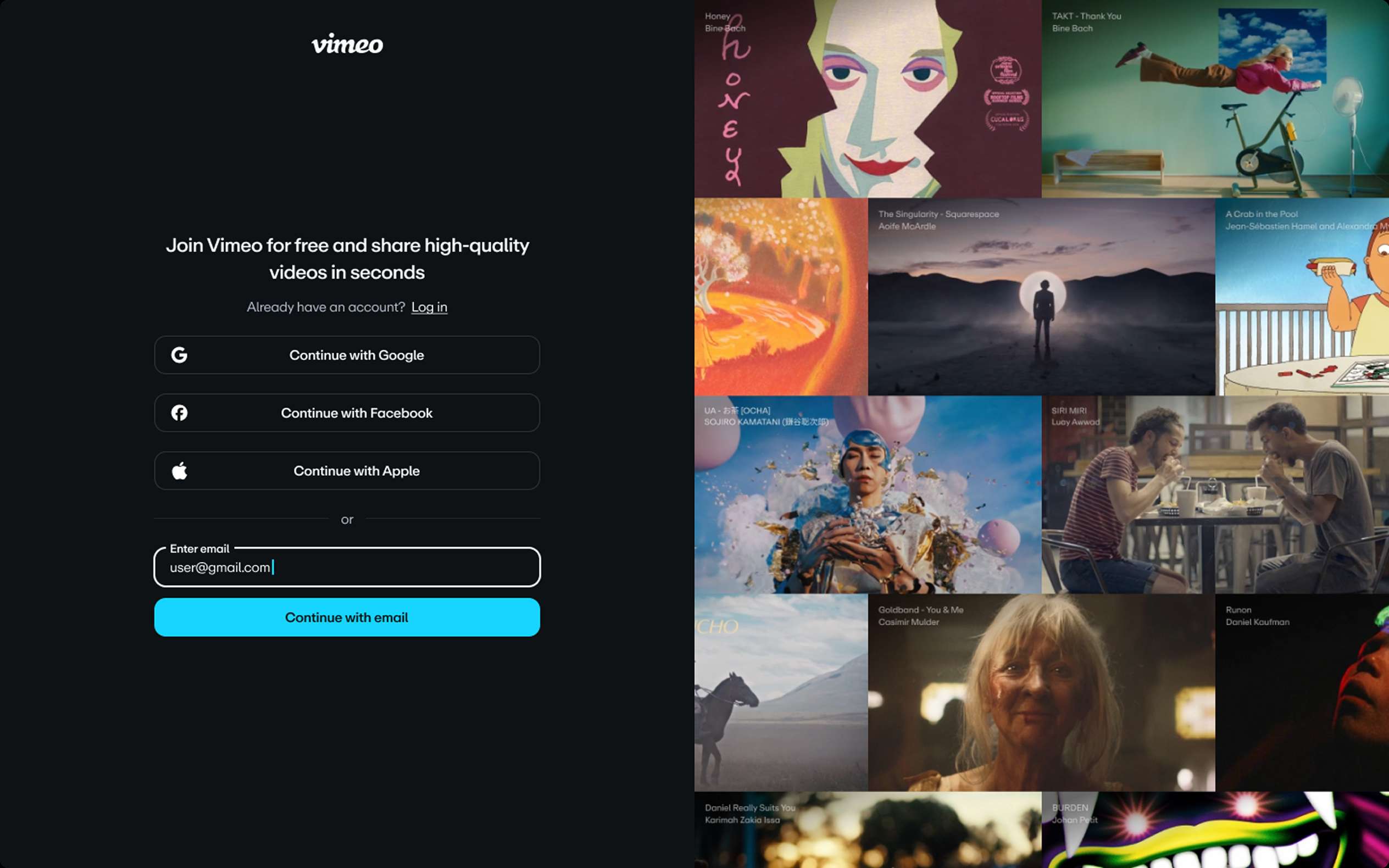
The registration flow included an automatically scrolling wall of video thumbnails in the background. That piece required more infrastructure than it might look like. I set up read-only access to an internal spreadsheet tracking which videos we had the rights to use. I built a Figma workspace that would import thumbnails and size them for both desktop and mobile layouts.
That same workspace also exported the atomic pieces a designer would need to update the After Effects animation. The After Effects file itself was templated so that swapping in new thumbnails only required replacing one source file. The whole system was designed so that a future designer could maintain it without rebuilding anything from scratch.
A note on the future
Future work on this project would have focused on reducing skip rates on the profiling questions, refining the questions themselves, and continuing to test how the answers could make plan selection more effective.
07
Reflections
Sequencing as a Design Strategy
Breaking a large registration redesign into three experiments wasn't just a risk-mitigation tactic. It was a way of learning incrementally. Each experiment gave us a cleaner signal about what was working and what wasn't. The tradeoff was speed. It took longer to ship the full vision. But the data quality at each stage was significantly better than it would have been from a single large change.
Profiling questions with a strategic plan
The customer profiling flow started as something Product Marketing needed. But it became the input that made personalization possible in experiments 2 and 3. It shifted from a data collection step to a decision-making input. That was one of the more interesting design problems in the project. The skip rate on those questions was something we were still working to reduce when I left.
Building the Thumbnail Wall
The registration flow included an automatically scrolling wall of video thumbnails in the background. That piece required more infrastructure than it might look like. I set up read-only access to an internal spreadsheet tracking which videos we had the rights to use. I built a Figma workspace that would import thumbnails and size them for both desktop and mobile layouts.
That same workspace also exported the atomic pieces a designer would need to update the After Effects animation. The After Effects file itself was templated so that swapping in new thumbnails only required replacing one source file. The whole system was designed so that a future designer could maintain it without rebuilding anything from scratch.
A note on the future
Future work on this project would have focused on reducing skip rates on the profiling questions, refining the questions themselves, and continuing to test how the answers could make plan selection more effective.