Terra
A lightweight daily game that helped teammates connect through shared music. Exploring AI-assisted design, authentication, and habit-forming product mechanics.
Terra
A lightweight daily game that helped teammates connect through shared music. Exploring AI-assisted design, authentication, and habit-forming product mechanics.
Principal Product Designer
Principal Product Designer
obsidian five three
2025
Personal project
01
Summary
Summary
Terra is an internal daily guessing game I built at Vimeo where players identify which teammate's music recap (Spotify or Apple Music) they're viewing. Each day offers one guess with immediate feedback.
The project explored authentication UX patterns, daily game mechanics, and AI-augmented design using Figma Make and Supabase.
Status
Rebuilding and launching
Terra was built as an internal tool at Vimeo and is not publicly available. I plan to rebuild and relaunch it as a standalone project in the future.

02
Goal
I had three core learning objectives in this project
I want to experiment with new technology to build a functioning application that didn’t run out of value fun the first time you played it.
Explore Authentication UX Patterns
I wanted to design authentication flows that felt seamless rather than administrative.
The challenge was creating different experiences for guest users, new users, and seeded participants (pre-existing profiles) while maintaining a consistent feel across all paths.
Extend Game Engagement
Early versions of Terra offered three rounds per day, but user engagement dropped significantly after the first round.
I hypothesized that constraining the game to one round per day would create anticipation and make each guess feel more meaningful.
Partner with AI in Design
I used AI tools throughout the design and development process to accelerate iteration, explore architectural options, and refine implementation details.
The goal was to understand where AI enhances design thinking versus where human judgment remains essential.
02
Goal
I had three core learning objectives in this project
I want to experiment with new technology to build a functioning application that didn’t run out of value fun the first time you played it.
Explore Authentication UX Patterns
I wanted to design authentication flows that felt seamless rather than administrative.
The challenge was creating different experiences for guest users, new users, and seeded participants (pre-existing profiles) while maintaining a consistent feel across all paths.
Extend Game Engagement
Early versions of Terra offered three rounds per day, but user engagement dropped significantly after the first round.
I hypothesized that constraining the game to one round per day would create anticipation and make each guess feel more meaningful.
Partner with AI in Design
I used AI tools throughout the design and development process to accelerate iteration, explore architectural options, and refine implementation details.
The goal was to understand where AI enhances design thinking versus where human judgment remains essential.
02
Goal
I had three core learning objectives in this project
I want to experiment with new technology to build a functioning application that didn’t run out of value fun the first time you played it.
Explore Authentication UX Patterns
I wanted to design authentication flows that felt seamless rather than administrative.
The challenge was creating different experiences for guest users, new users, and seeded participants (pre-existing profiles) while maintaining a consistent feel across all paths.
Extend Game Engagement
Early versions of Terra offered three rounds per day, but user engagement dropped significantly after the first round.
I hypothesized that constraining the game to one round per day would create anticipation and make each guess feel more meaningful.
Partner with AI in Design
I used AI tools throughout the design and development process to accelerate iteration, explore architectural options, and refine implementation details.
The goal was to understand where AI enhances design thinking versus where human judgment remains essential.
03
Process
01
Technical foundation
02
Authentication Evolution
The authentication flow went through three major iterations:
v0: Basic Foundation
A variety of integrated systems and methodologies have been employed to boost the operational productivity of this initiative's course.
v0.5: Seeded User Detection
Added logic to detect when someone with an existing music recap was trying to sign up. This prevented duplicate accounts but created a clunky experience where users had to claim their profile separately.
v1: Unified Progressive Experience
Redesigned the entire flow to support three distinct paths—guest play, new user onboarding, and profile claiming—while maintaining visual and experiential consistency. This version introduced guest play with localStorage tracking, allowing anyone to try the game before committing to authentication.
03
Game Mechanics Iteration
04
AI-Augmented Workflow
05
Asset Generation System
Technical foundation
Authentication Evolution
The authentication flow went through three major iterations:
v0: Basic Foundation
A variety of integrated systems and methodologies have been employed to boost the operational productivity of this initiative's course.
v0.5: Seeded User Detection
Added logic to detect when someone with an existing music recap was trying to sign up. This prevented duplicate accounts but created a clunky experience where users had to claim their profile separately.
v1: Unified Progressive Experience
Redesigned the entire flow to support three distinct paths—guest play, new user onboarding, and profile claiming—while maintaining visual and experiential consistency. This version introduced guest play with localStorage tracking, allowing anyone to try the game before committing to authentication.
Game Mechanics Iteration
AI-Augmented Workflow
Asset Generation System
03
Process
Technical foundation
Authentication Evolution
The authentication flow went through three major iterations:
v0: Basic Foundation
A variety of integrated systems and methodologies have been employed to boost the operational productivity of this initiative's course.
v0.5: Seeded User Detection
Added logic to detect when someone with an existing music recap was trying to sign up. This prevented duplicate accounts but created a clunky experience where users had to claim their profile separately.
v1: Unified Progressive Experience
Redesigned the entire flow to support three distinct paths—guest play, new user onboarding, and profile claiming—while maintaining visual and experiential consistency. This version introduced guest play with localStorage tracking, allowing anyone to try the game before committing to authentication.
Game Mechanics Iteration
AI-Augmented Workflow
Asset Generation System
Technical foundation
Authentication Evolution
The authentication flow went through three major iterations:
v0: Basic Foundation
A variety of integrated systems and methodologies have been employed to boost the operational productivity of this initiative's course.
v0.5: Seeded User Detection
Added logic to detect when someone with an existing music recap was trying to sign up. This prevented duplicate accounts but created a clunky experience where users had to claim their profile separately.
v1: Unified Progressive Experience
Redesigned the entire flow to support three distinct paths—guest play, new user onboarding, and profile claiming—while maintaining visual and experiential consistency. This version introduced guest play with localStorage tracking, allowing anyone to try the game before committing to authentication.
Game Mechanics Iteration
AI-Augmented Workflow
Asset Generation System
05
Solution
001 / 005
What i built
From WrappedMatch to Terra
Terra, originally called Wrappedmatch, started as a quick Figma prototype to learn more about my coworkers' musical tastes. What seemed like a simple icebreaker concept evolved into an exploration of frictionless authentication, daily engagement mechanics, and AI-augmented development workflows.
How It Works
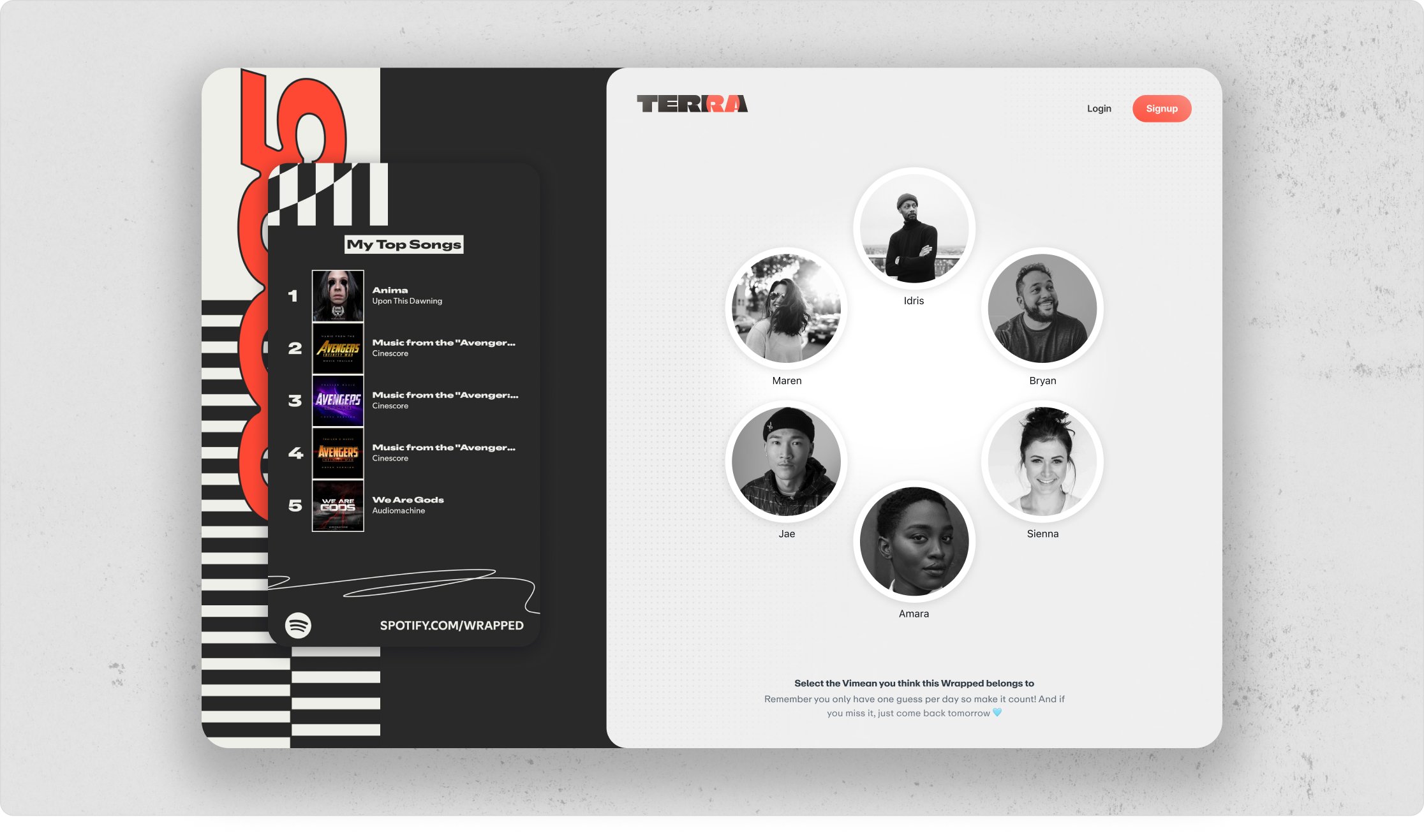
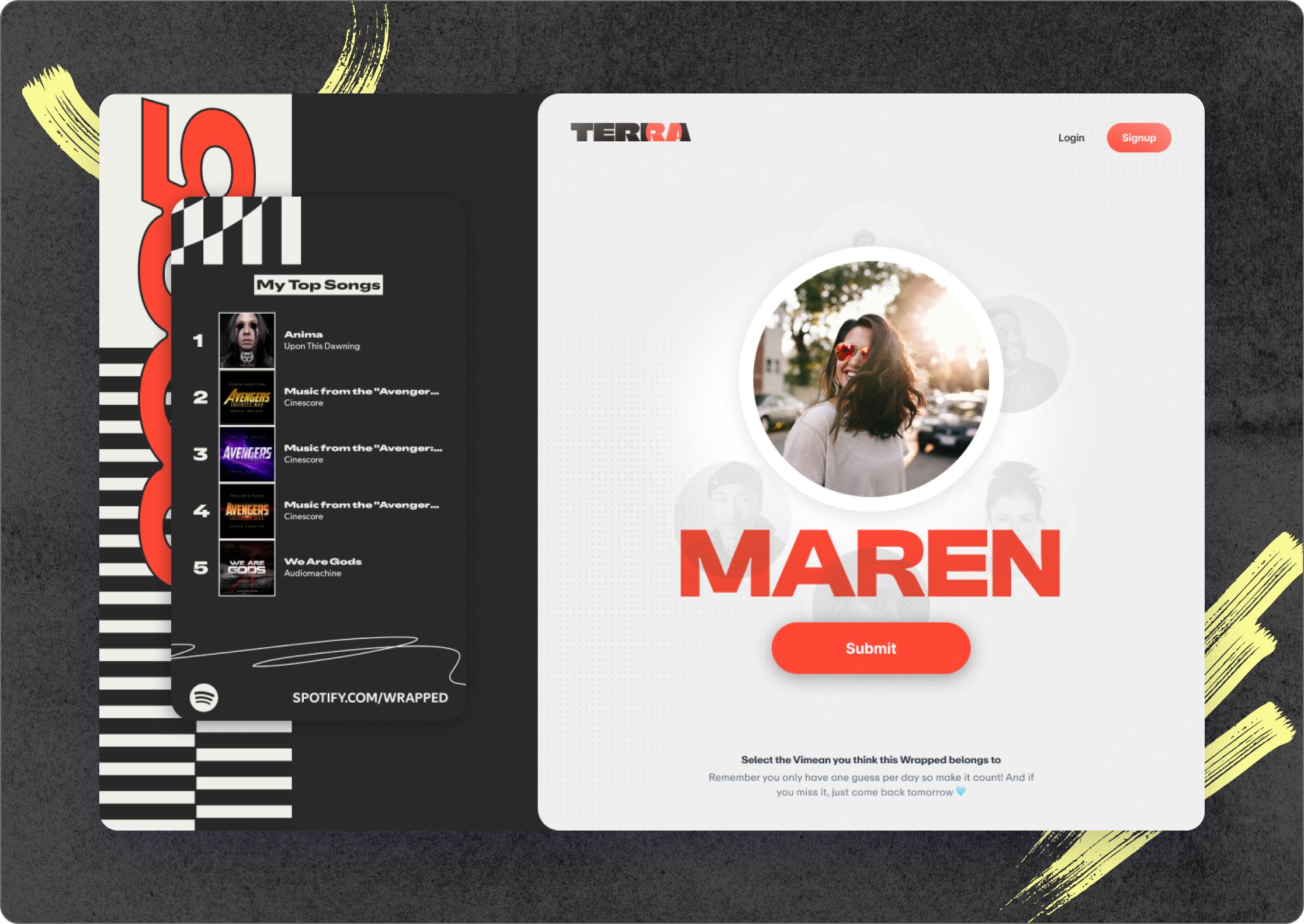
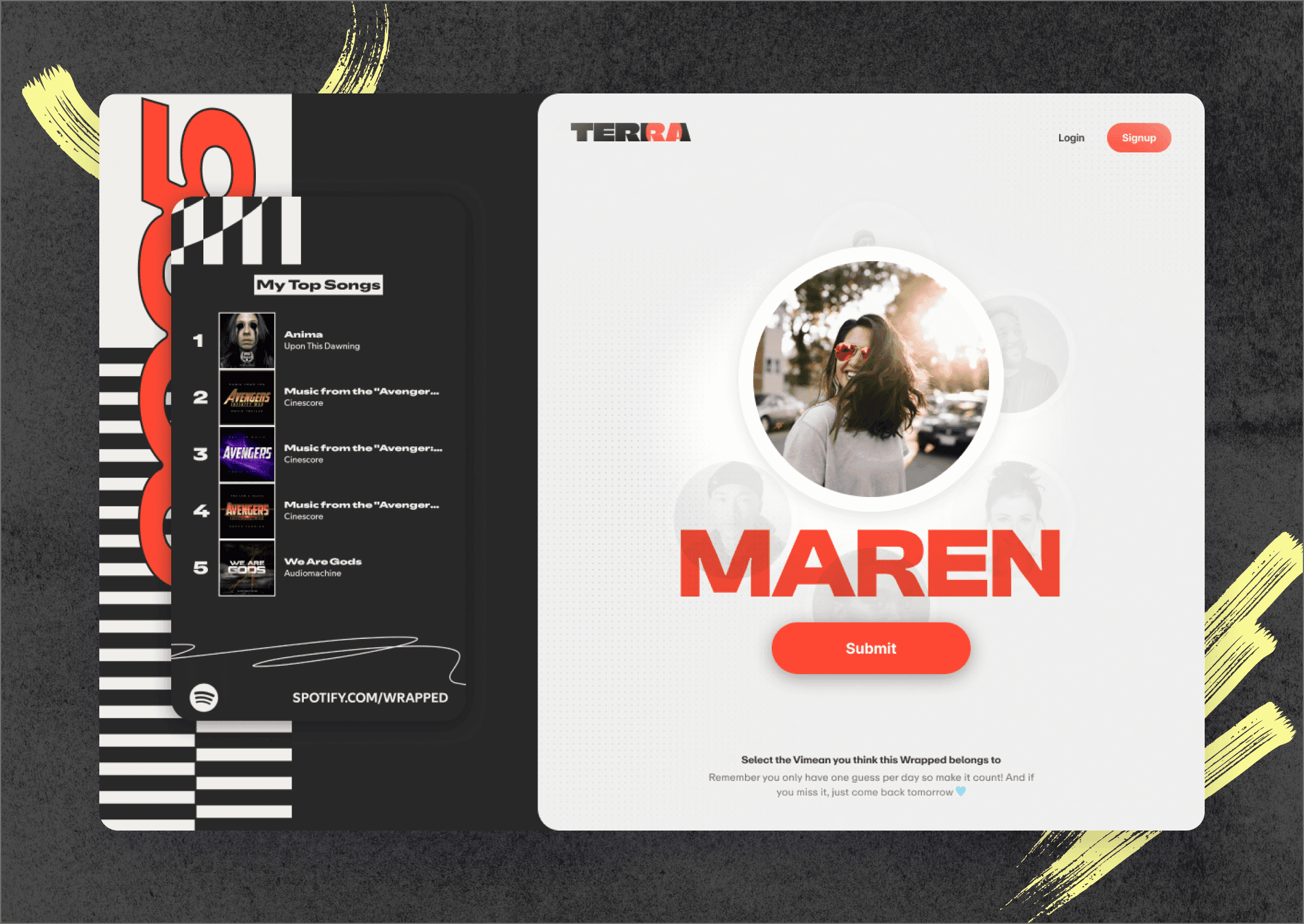
The game presents players with a Spotify Wrapped or Apple Music Replay visualization and challenges them to identify which teammate it belongs to from a selection of avatars. Correct guesses increase your score, incorrect guesses simply invite you to return tomorrow. One guess per day, every day a new challenge.
These sections include "A New Experience" with new user metrics and error rates, and "Find relevant data, faster" with usage patterns and session analysis.
05
Solution
001 / 005
What i built
From WrappedMatch to Terra
Terra, originally called Wrappedmatch, started as a quick Figma prototype to learn more about my coworkers' musical tastes. What seemed like a simple icebreaker concept evolved into an exploration of frictionless authentication, daily engagement mechanics, and AI-augmented development workflows.
How It Works
The game presents players with a Spotify Wrapped or Apple Music Replay visualization and challenges them to identify which teammate it belongs to from a selection of avatars. Correct guesses increase your score, incorrect guesses simply invite you to return tomorrow. One guess per day, every day a new challenge.
These sections include "A New Experience" with new user metrics and error rates, and "Find relevant data, faster" with usage patterns and session analysis.
05
Solution
001 / 005
What i built
From WrappedMatch to Terra
Terra, originally called Wrappedmatch, started as a quick Figma prototype to learn more about my coworkers' musical tastes. What seemed like a simple icebreaker concept evolved into an exploration of frictionless authentication, daily engagement mechanics, and AI-augmented development workflows.
How It Works
The game presents players with a Spotify Wrapped or Apple Music Replay visualization and challenges them to identify which teammate it belongs to from a selection of avatars. Correct guesses increase your score, incorrect guesses simply invite you to return tomorrow. One guess per day, every day a new challenge.
These sections include "A New Experience" with new user metrics and error rates, and "Find relevant data, faster" with usage patterns and session analysis.
05
Reflections
Authentication as UX, Not Infrastructure
Treating authentication flows as core product experience rather than a technical requirement led to more thoughtful solutions. The progressive disclosure approach and profile claiming flow demonstrate that security doesn't have to feel administrative.
Driving Clarity Through Simplification
The decision to limit Terra to a single guess per day was a constraint that went a long way toward simplifying the game. This constraint eliminated the complexity of managing multiple rounds, removed the drop-off problem after the first guess, and transformed each daily interaction into a more focused, meaningful ritual.
AI Accelerates, Judgment Decides
AI tools significantly sped up iteration and helped explore architectural options, but every decision still required human judgment. The most successful outcomes came from using AI for velocity while protecting core design system decisions and scope management from automation.
05
Reflections
Authentication as UX, Not Infrastructure
Treating authentication flows as core product experience rather than a technical requirement led to more thoughtful solutions. The progressive disclosure approach and profile claiming flow demonstrate that security doesn't have to feel administrative.
Driving Clarity Through Simplification
The decision to limit Terra to a single guess per day was a constraint that went a long way toward simplifying the game. This constraint eliminated the complexity of managing multiple rounds, removed the drop-off problem after the first guess, and transformed each daily interaction into a more focused, meaningful ritual.
AI Accelerates, Judgment Decides
AI tools significantly sped up iteration and helped explore architectural options, but every decision still required human judgment. The most successful outcomes came from using AI for velocity while protecting core design system decisions and scope management from automation.
05
Reflections
Authentication as UX, Not Infrastructure
Treating authentication flows as core product experience rather than a technical requirement led to more thoughtful solutions. The progressive disclosure approach and profile claiming flow demonstrate that security doesn't have to feel administrative.
Driving Clarity Through Simplification
The decision to limit Terra to a single guess per day was a constraint that went a long way toward simplifying the game. This constraint eliminated the complexity of managing multiple rounds, removed the drop-off problem after the first guess, and transformed each daily interaction into a more focused, meaningful ritual.
AI Accelerates, Judgment Decides
The registration flow included an automatically scrolling wall of video thumbnails in the background. That piece required more infrastructure than it might look like. I set up read-only access to an internal spreadsheet tracking which videos we had the rights to use. I built a Figma workspace that would import thumbnails and size them for both desktop and mobile layouts.
That same workspace also exported the atomic pieces a designer would need to update the After Effects animation. The After Effects file itself was templated so that swapping in new thumbnails only required replacing one source file. The whole system was designed so that a future designer could maintain it without rebuilding anything from scratch.